Gold, silver, and bronze — veterinary care standard tiering has moved from informal clinical shorthand into a structured framework that affects how you hire, how you credential, and what skill sets your staff actually needs to deliver each level of care.
As more practices explicitly adopt tiered care frameworks — whether under AAHA’s influence, internal protocol development, or client communication initiatives — the credentialing and staffing implications become concrete. A practice advertising gold-standard diagnostics and surgery without the staff depth to deliver it is a liability, both clinically and from a client trust standpoint.
This guide breaks down what each care tier actually requires from a workforce perspective, and how to build the staffing structure that makes your chosen tier sustainable.
What the Tiered Care Framework Actually Means
The gold, silver, bronze framework is primarily a clinical communication tool — a way to discuss with clients the range of diagnostic and treatment options available given their pet’s condition and their resources. But the framework has direct staffing implications because each tier requires different equipment proficiency, procedural skills, and clinical judgment from your team.
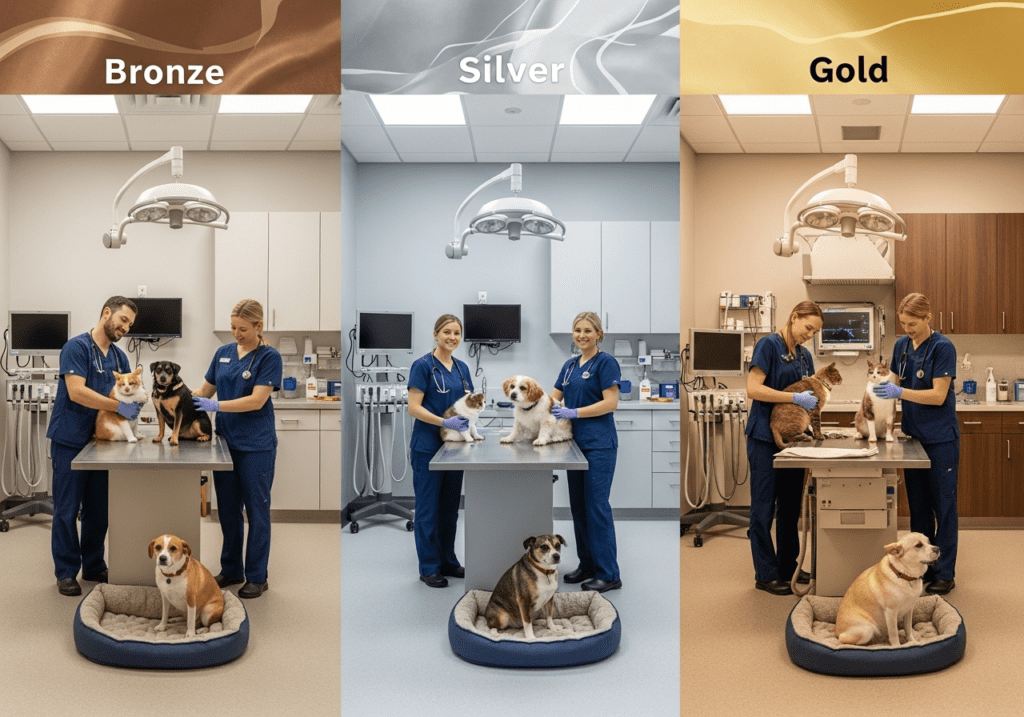
Gold-tier care represents the diagnostic and treatment ceiling: advanced imaging (CT, MRI, or high-resolution ultrasound), specialist-level surgery, comprehensive bloodwork panels, and multi-specialist case management. Delivering gold-tier care consistently requires DVMs with advanced training, specialty-credentialed staff or specialist referral relationships, and technicians trained in advanced monitoring and anesthesia management.
Silver-tier care is the standard of thorough general practice: radiographs, routine bloodwork, standard surgical procedures, and evidence-based treatment protocols. Most well-staffed general practices deliver silver-tier care when properly staffed with credentialed LVTs and experienced DVMs. This is the staffing benchmark most clinic owners should be hiring to.
Bronze-tier care represents minimum acceptable care given resource or access constraints: essential diagnostics, basic treatment, stabilization before referral. Bronze-tier staffing still requires licensed professionals — it simply reflects the limitation of available resources rather than a staffing capability gap.
Gold-Tier: What Staffing Does It Actually Require?
If your practice is marketing itself as gold-tier or equivalent, your staffing must support it. The specific roles and credentials that sustain gold-tier delivery include:
- DVMs with advanced procedural training: minimally invasive surgery, advanced dental procedures, interventional radiology, or specialty medicine focus areas. These are not standard new-grad capabilities — they require additional training, often through residency, CE-intensive specialty tracks, or extended mentored experience
- Credentialed veterinary technicians (CVT/LVT) with advanced monitoring skills: gold-tier anesthesia and surgery requires technicians who can manage complex anesthetic cases independently, not just observe
- Imaging-trained staff: if you have ultrasound or digital radiography, you need at least one DVM or LVT with formal training in image acquisition and interpretation — not just ownership of the equipment
- Adequate DVM-to-technician ratios: gold-tier care cannot be delivered safely with a solo DVM and a team of unlicensed assistants. The skill mix matters as much as the headcount
Silver-Tier: The Hiring Baseline Every General Practice Should Meet
Silver-tier delivery represents the practical staffing target for most general practices. The minimum team structure that consistently delivers silver-tier care:
- At least one credentialed LVT per DVM working during surgical and procedure-heavy shifts
- DVMs with current DEA registration and controlled substance handling protocols in place
- Documented training for all team members on PIMS (practice management software), pharmaceutical protocols, and client communication standards
- A CE program that keeps credentialed staff current — NAVTA recommends 15+ CE hours per year for LVTs
The gap between bronze and silver delivery at most practices is not equipment — it is the absence of enough credentialed staff to execute protocols correctly under the volume of a full day’s schedule.
Credentialing as a Competitive Differentiator in Hiring
Practices that have invested in gold or silver-tier capability can use it as a genuine recruiting asset — but only if it is credible and operational. DVMs considering a practice ask about case complexity and equipment access because they want to keep developing clinically. A practice that can genuinely offer advanced surgical cases, specialty equipment, and a team capable of handling complex presentations attracts stronger DVM candidates than one that promises development opportunities it can’t deliver.
When recruiting DVMs and LVTs, be specific about what your practice actually offers:
- What is your surgical caseload and average complexity?
- What imaging equipment do you have and what is the training pathway for new hires on that equipment?
- What is the LVT-to-DVM ratio during a typical surgical day?
- What CE does your practice support for the skills needed at your care tier?
Candidates who are well-suited to your care tier will self-select toward clarity. Candidates who leave quickly are often those who found the role’s actual complexity was different than advertised.
Building the Team Your Care Standard Requires
Matching your staffing to your stated care standard is both a clinical obligation and a business decision. Practices that staff below their marketed tier face higher rates of clinical mistakes, staff burnout (when under-supported staff are asked to deliver above their training), and client trust erosion when expectations aren’t met.
Pulivarthi Group places DVMs and credentialed veterinary technicians in practices across the care-tier spectrum. Whether you are building a gold-tier surgical team, replacing a departure at a general practice, or staffing a newly opened clinic from scratch, we match candidates to roles where the clinical expectations align with their training and experience. Connect with our veterinary staffing team to discuss the specific credentials and experience level you need.
Sources
- AAHA (American Animal Hospital Association): Standards and Accreditation Framework
- AVMA Policy on Veterinary Technician Utilization and Credentialing
- NAVTA (National Association of Veterinary Technicians in America): CE Recommendations and Scope of Practice Guidelines
- Journal of the American Veterinary Medical Association: Tiered Care Communication Research