

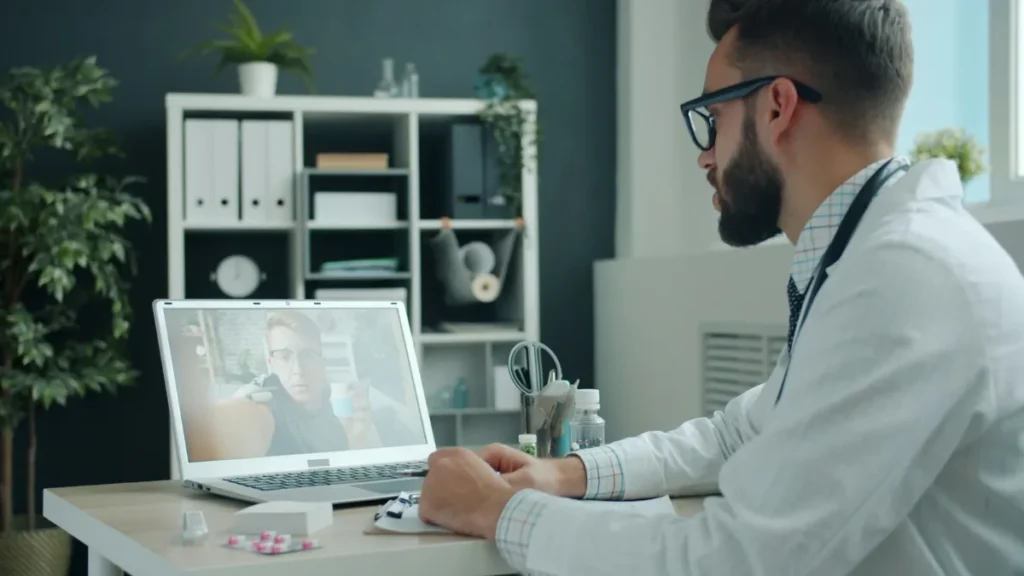
Remote Psychiatric Nurse Practitioner Staffing for Clinics, FQHCs and Telehealth Programs
Need psychiatric prescribing but cannot find a local provider? Remote psychiatric nurse practitioner staffing places a licensed, board-certified telehealth PMHNP (psychiatric-mental health nurse practitioner) into your schedule by secure video. Pulivarthi Group finds PMHNPs who hold a license in the state where your patients are, carry a DEA registration and can work in your EHR. As a result, rural clinics, health centers and virtual programs can add psychiatric care without waiting for a local hire.
Last updated: October 26, 2026
A telehealth PMHNP does the same work as an on-site PMHNP. In short, they evaluate, diagnose, prescribe and follow up. However, remote work adds rules on top. The PMHNP must be licensed where the patient sits, follow DEA telemedicine rules and meet your state’s collaboration rules. So this guide covers each one, plus workflow, pay and hiring steps.
Why Hire a Telehealth PMHNP?
Psychiatric prescribers are scarce, especially outside cities. According to the Health Resources and Services Administration (HRSA), about 157.1 million people lived in a Mental Health Professional Shortage Area as of June 30, 2026. That is close to half of the U.S. population. In addition, HRSA projects that adult psychiatrist supply will meet only about half of demand by 2038 under current care patterns.
Fortunately, remote PMHNPs help close that gap. Here is why many employers choose them:
- A wider candidate pool: You are no longer limited to clinicians who live within driving distance. Instead, you can hire anyone licensed in your patients’ state.
- Flexible coverage: You can start with a few half-day blocks each week. Then you can scale up as your waitlist grows.
- Less travel time: Multi-site groups no longer pay for drive time between clinics. As a result, more of each shift goes to patient care.
- Lower cost than physician coverage: PMHNP pay sits below psychiatrist pay. So a remote PMHNP can stretch your prescribing budget.
- Continuity of care: A steady remote PMHNP sees the same patients each month. This builds trust and supports follow-up.
For a broader view of remote psychiatry models, read our telepsychiatry staffing guide.
Where Telepsychiatry Providers and Psychiatric Nurse Practitioners Work
Telepsychiatry providers and psychiatric nurse practitioners fit many settings. However, each one needs a slightly different setup.
- Rural clinics and rural health clinics (RHCs): A remote PMHNP sees patients who come into the clinic. An on-site nurse or medical assistant rooms the patient and starts the video visit.
- Federally qualified health centers (FQHCs): Remote PMHNPs often support primary care teams through medication management and consults.
- Community mental health centers: Remote prescribers cover evaluations and follow-ups across several sites.
- Telehealth companies: PMHNPs see patients at home across one or more states.
- Hospitals and emergency departments: Remote PMHNPs can support psychiatric consults where state law and hospital bylaws allow.
- Collaborative care programs: A PMHNP can act as the psychiatric consultant to primary care and a behavioral health care manager.
- Addiction treatment programs: Remote PMHNPs with the right training can support medications for opioid use disorder (MOUD).
Licensure in the Patient’s State and the APRN Compact
First, the most important rule is simple. A remote PMHNP must hold an active APRN license in the state where the patient is located during the visit. In other words, where the PMHNP lives does not decide this. For example, a PMHNP in Colorado who sees a patient in Kansas needs a Kansas license.
Many telehealth PMHNPs therefore hold several state licenses. This lets them cover multi-state programs. However, each new license takes time, fees and paperwork. So plan your states before you start the search.
APRN Compact status
The APRN Compact would allow one multistate license for nurse practitioners. However, it is not in effect yet. It takes effect only after seven states enact it. As of our last check, four states had joined: Delaware, North Dakota, South Dakota and Utah. Until then, plan on a separate license for each state. Note that the Nurse Licensure Compact for registered nurses does not cover APRN practice.
DEA Telemedicine Prescribing Rules Through December 31, 2026
Many psychiatric patients need controlled medications. For instance, examples include stimulants for ADHD and some sleep or anxiety medications. So DEA rules matter a great deal for telehealth PMHNPs.
The Drug Enforcement Administration (DEA) and HHS extended the COVID-era telemedicine flexibilities through December 31, 2026. Under this fourth extension, DEA-registered practitioners may prescribe Schedule II to V medications over audio-video telehealth without first seeing the patient in person. In addition, certain medications for opioid use disorder may be prescribed through audio-only visits. All prescriptions must still follow DEA rules and state law.
Source: DEA press release, December 31, 2025.
What this means for your hire
- DEA registration by state: DEA registration is tied to a state. Therefore, a PMHNP who prescribes in several states generally needs a registration for each one.
- State controlled-substance rules: Some states require a separate state registration. Others add their own telehealth limits.
- Plan for 2027: The current flexibilities are temporary. So build a fallback, such as an in-person option for patients on controlled medications.
Medicare Telehealth Rules for Mental Health Through 2027
Medicare rules shape how much remote psychiatric care you can bill. Fortunately, behavioral health has the most stable rules in telehealth. According to HHS, these Medicare flexibilities are permanent for behavioral and mental health care:
- Patients can receive care in their home.
- There are no geographic limits on where the patient is located.
- Visits can use audio-only technology.
- FQHCs and RHCs can serve as distant site providers.
In addition, the in-person visit requirement for telemental health is waived through December 31, 2027. After that date, the requirement may return unless Congress acts again. Therefore, track this date in your compliance calendar.
Source: HHS Telehealth Policy Updates (updated February 2026). Medicaid and commercial rules vary by state and plan.
Collaboration and Supervision Rules by State
Similarly, state law decides how independently a PMHNP can practice. The American Association of Nurse Practitioners (AANP) groups states into three types. Per AANP data reported in 2026, 27 states and Washington, D.C. grant full practice authority. For remote roles, the rule that applies is usually the one in the patient’s state.
| Practice type | What it means | What to plan for a remote PMHNP |
|---|---|---|
| Full practice | The PMHNP can evaluate, diagnose and prescribe under the board of nursing alone. | No physician agreement needed. Fastest to start. |
| Reduced practice | A career-long collaborative agreement is needed for at least one part of practice. | Name a collaborating physician. Check whether that physician must hold a license in the same state. |
| Restricted practice | Career-long supervision or delegation by another provider is required. | Set up supervision, chart review and meeting rules before the first visit. |
Some states also have “transition to practice” hours for newer NPs. So confirm the PMHNP’s practice hours if they are newly licensed. We check these rules for each state at the start of every search.
Telehealth PMHNP vs. On-Site PMHNP vs. Telepsychiatrist
Not sure which remote prescriber fits? In that case, this table compares the main options.
| Factor | Telehealth PMHNP | On-site PMHNP | Telepsychiatrist (MD/DO) |
|---|---|---|---|
| Credential | APRN license + PMHNP-BC | APRN license + PMHNP-BC | Medical license + board eligibility or certification |
| License needed | Each state where patients are located | Your state only | Each state where patients are located |
| Physician collaboration | Depends on patient’s state | Depends on your state | Not needed |
| Best for | Rural sites, multi-site groups, home-based care | High-acuity, in-person programs | Complex cases, supervision, inpatient consults |
| Typical cost | Lower than physician coverage | Lower than physician coverage | Highest |
Many programs mix these roles. For example, a telepsychiatrist handles complex cases while a remote PMHNP manages stable follow-ups. For on-site roles, see our page on how to hire a PMHNP, or hire a psychiatrist.
Remote Psychiatric Nurse Practitioner Staffing Services for Rural Clinics
In particular, rural clinics often feel the shortage most. Recruiting a full-time local prescriber can also take a long time. In addition, many small clinics do not have enough volume for a full-time hire. Remote psychiatric nurse practitioner staffing solves both problems.
How a rural telehealth PMHNP visit works
- Before the visit: Your front desk schedules the patient. The PMHNP then reviews the chart, including primary care notes.
- Check-in: An on-site nurse or medical assistant takes vitals and reviews medications. Then they start the secure video call.
- The visit: The PMHNP completes the evaluation, charts in your EHR and sends prescriptions electronically.
- After the visit: Your staff books follow-ups, orders labs and handles any care coordination.
Tips for FQHCs and rural health clinics
- Start small with recurring half-day blocks. Then add time as slots fill.
- Confirm the visits by phone a day before to reduce no-shows.
- Keep a short waitlist so you can fill last-minute cancellations.
- Credential the PMHNP with your main payers early, because enrollment can take months.
Running a small practice? Our guide to behavioral health staffing for small clinics covers more options.
Technology and Workflow Checklist for Remote PMHNPs
Meanwhile, good technology keeps remote visits safe and smooth. Before day one, confirm each item below.
- HIPAA-compliant video platform: Use a platform that signs a business associate agreement (BAA).
- EHR access: Give the PMHNP full remote access, including notes, labs and messaging.
- Electronic prescribing: Set up e-prescribing, including electronic prescribing for controlled substances (EPCS) that meets DEA rules.
- Prescription monitoring: Give access to the state prescription drug monitoring program (PDMP). Many states require a check before certain prescriptions.
- Patient location and identity: Confirm where the patient is at the start of each visit. Also verify identity.
- Emergency plan: Keep local crisis contacts for each patient location. Also define who calls 988 or emergency services if needed.
- Backup plan: Agree on a phone backup if video drops.
- Consent: Collect telehealth consent as your state and payers require.
Staffing Models for Remote PMHNPs
In addition, remote PMHNP coverage comes in several shapes. Pick the one that matches your volume and budget.
| Model | Best for | How it works |
|---|---|---|
| Permanent remote hire | Steady, long-term demand | The PMHNP joins your staff and works remotely full-time or part-time. |
| Contract or temporary | Launches, leave cover and pilots | A fixed-term contract, billed by the hour or block. |
| Per diem blocks | Small clinics and uneven demand | Recurring half-day or full-day blocks you can add or drop. |
| Hybrid | Programs needing some in-person time | Mostly remote, with set on-site days. |
| Executive search | Telehealth clinical leaders | A focused search for a lead PMHNP or program director. |
Want to understand budget first? See our guide to the cost to hire a telepsychiatrist.
Remote PMHNP Hiring Challenges and Solutions
- Licensing lag: New state licenses can take weeks or months. Solution: hire PMHNPs who already hold your state license, or start applications at offer stage.
- Payer credentialing delays: Remote clinicians still need enrollment with each payer. Solution: gather documents during the offer stage.
- Isolation and turnover: Remote clinicians can feel cut off. Solution: add regular team huddles and case reviews.
- Rule changes: DEA and Medicare dates can shift. Solution: name one owner to track telehealth rules.
- Crisis risk at a distance: Emergencies are harder to manage remotely. Solution: build a written crisis plan for every patient location.
In fact, we have handled these delays before. Read our case study on multi-state licensure and DEA timelines for PMHNP hiring.
Telehealth PMHNP Qualifications and Licensure Checklist
- MSN or DNP from an accredited psychiatric-mental health NP program
- Current PMHNP-BC certification from the American Nurses Credentialing Center (ANCC)
- Active, unrestricted APRN license in every state where patients are located
- DEA registration for each state where they prescribe controlled substances
- State controlled-substance registration where required
- Collaborative or supervision agreement where the patient’s state requires one
- Telehealth experience, including remote crisis handling
- Comfort with your EHR, EPCS and PDMP tools
- Clean sanctions, malpractice and board-action history in all states
- A private, secure and quiet workspace with reliable internet
Sample Telehealth PMHNP Job Description
Job Title: Telehealth Psychiatric-Mental Health Nurse Practitioner (PMHNP)
Location: Remote (patients located in [State(s)])
Employment Type: [Full-Time / Part-Time / Contract / Per Diem]
Schedule: [Days and hours, time zone]
Reports To: Medical Director / Clinical Director

Job Overview:
We are looking for a board-certified PMHNP to provide psychiatric
care by secure video. You will complete evaluations, manage
medications and work with our on-site and remote care team.

Key Responsibilities:
- Complete psychiatric evaluations and follow-up visits by video
- Prescribe and manage medications, including EPCS where needed
- Check the state PDMP as required
- Confirm patient location and identity at each visit
- Follow crisis and safety protocols for each patient location
- Chart in our EHR within [time frame]
- Join weekly team huddles and case reviews

Required Qualifications:
- MSN or DNP from an accredited PMHNP program
- Current PMHNP-BC certification (ANCC)
- Active, unrestricted APRN license in [State(s)]
- DEA registration in [State(s)], or able to obtain before start
- Telehealth experience preferred
- Private workspace and reliable high-speed internet

What We Offer:
- Pay: [hourly rate or salary range]
- Malpractice coverage that includes telehealth
- Licensing and DEA fee support for added states
- Continuing education allowance
- A supportive remote team
Interview Questions for a Remote PMHNP (and What You Are Measuring)
- “How do you confirm a patient’s location and handle a crisis on video?” Measures safety planning and telehealth judgment.
- “Which states are you licensed in, and do you hold a DEA registration in each?” Measures licensing readiness and accuracy.
- “How do you decide when a controlled medication needs an in-person visit?” Measures knowledge of DEA rules and safe prescribing.
- “How do you build rapport over video?” Measures engagement skills in a remote setting.
- “How do you work with on-site staff you have never met in person?” Measures communication and teamwork.
- “What do you do when the video connection fails mid-visit?” Measures planning and calm problem-solving.
Telehealth PMHNP Compensation Benchmarks
The U.S. Bureau of Labor Statistics (BLS) does not publish separate pay data for PMHNPs or telehealth roles. Instead, it reports pay for all nurse practitioners. According to BLS, the median annual pay for nurse practitioners was $132,300 in May 2025. BLS also projects 41% job growth for nurse practitioners from 2025 to 2035.
Remote PMHNP offers move above or below that median for several reasons:
- Number of state licenses: PMHNPs licensed in many states are in high demand.
- Controlled-substance experience: Comfort with telehealth stimulant or MOUD prescribing can raise offers.
- Schedule: Evening, weekend and urgent slots usually pay more.
- Pay model: Hourly, per-visit and salaried models all exist. Hence, compare total cost, not just the rate.
Also budget for licensing fees, DEA registrations, malpractice coverage and technology. After all, these costs are easy to miss.
Source: BLS Occupational Outlook Handbook, Nurse Practitioners.
How to Retain Remote PMHNPs
- Keep schedules stable: Predictable blocks help remote PMHNPs plan their week.
- Protect documentation time: Build charting time into each block.
- Connect them to the team: Hold regular huddles with on-site staff.
- Pay for added licenses: Covering license and DEA fees shows you value their time.
- Give feedback often: Short monthly check-ins catch problems early.
How Pulivarthi Group Delivers Remote PMHNPs
Pulivarthi Group has 15 years in healthcare staffing. Our network includes more than 20,000 licensed clinicians, and we have served more than 5,000 healthcare clients across the U.S. and Canada. For remote psychiatric nurse practitioner staffing, we focus on the rules that slow telehealth hires.
- Patient-state licensing first: We match PMHNPs to the states where your patients are located.
- Full verification: We verify licenses and credentials across all 50 states, including PMHNP-BC and DEA registration.
- Collaboration check: We confirm each state’s practice rules before we present candidates.
- Flexible models: We offer permanent, temporary, contract, per diem and executive search.
- 30-day placement guarantee: If the fit isn’t right, we make it right at no additional cost.
We also staff the wider team, from on-site prescribers to therapists, through our mental health staffing services.
Ready to add a telehealth PMHNP? Request a quote and tell us your patient states, schedule and setting. We will come back with a plan and a shortlist.
Telehealth PMHNP Staffing: Frequently Asked Questions
What is remote psychiatric nurse practitioner staffing?
It is a service that places licensed PMHNPs into your schedule to see patients by secure video. The staffing firm finds, screens and credentials the PMHNP. You get psychiatric prescribing without a local hire.
Does a telehealth PMHNP need a license in the patient’s state?
Yes. A remote PMHNP needs an active APRN license in the state where the patient is located during the visit. Where the PMHNP lives does not change this rule.
Can a telehealth PMHNP prescribe controlled substances?
Yes, within limits. DEA telemedicine flexibilities run through December 31, 2026. They let DEA-registered practitioners prescribe Schedule II to V medications by audio-video visit without an in-person exam first. State law still applies.
Is the APRN Compact in effect?
No. The APRN Compact takes effect only after seven states enact it. As of our last check, four states had joined. Until then, remote PMHNPs need a separate license for each state.
Does Medicare cover telehealth mental health visits at home?
Yes. According to HHS, home-based behavioral health telehealth and audio-only visits are permanent Medicare rules. The in-person visit requirement is waived through December 31, 2027.
Do remote PMHNPs need a collaborating physician?
It depends on the patient’s state. Per AANP data reported in 2026, 27 states and Washington, D.C. allow full practice authority. Other states require a collaborative agreement or supervision.
Can FQHCs and rural health clinics use remote PMHNPs?
Yes. HHS lists FQHCs and rural health clinics as permanent Medicare distant site providers for behavioral health. Many rural clinics use an on-site nurse to room patients for remote visits.
How much does a telehealth PMHNP cost?
Costs depend on schedule, states and staffing model. For reference, BLS reports a median annual pay of $132,300 for all nurse practitioners in May 2025. Also budget for licenses, DEA fees and malpractice coverage.
How fast can I add a remote PMHNP?
It is fastest when the PMHNP already holds your patients’ state license and DEA registration. New licenses and payer enrollment add time. So start credentialing as soon as you sign an offer.